The boulder goes up faster. The constraint was never the pushing.
That division is the whole shape of the work now. The agent on implementation. The person on direction.
The team is the check on what the tool can't see.
Implementation got cheap. Discovering it was wrong didn't.
The form doesn't matter, but the instinct does.
AI agreement is cheap. Human agreement from the right person is not.
We were still in the room together. We had stopped thinking together.
We used to confuse effort with value. AI lets us confuse output with value.
The minimum viable unit is three people.
The organization scales understanding by carrying patterns between rooms.
Without people saying what they actually think, nothing else holds.
Choose the forest. Even when the desert feels faster. Especially when it feels faster.
AI erodes the incidental friction that used to produce a shared picture
of what to build and why as a byproduct of the work. That makes
shared understanding the scarce resource, and constructive
friction the mechanism that protects it. This book is the argument for why
teams that keep that friction will outperform teams that optimize it away.
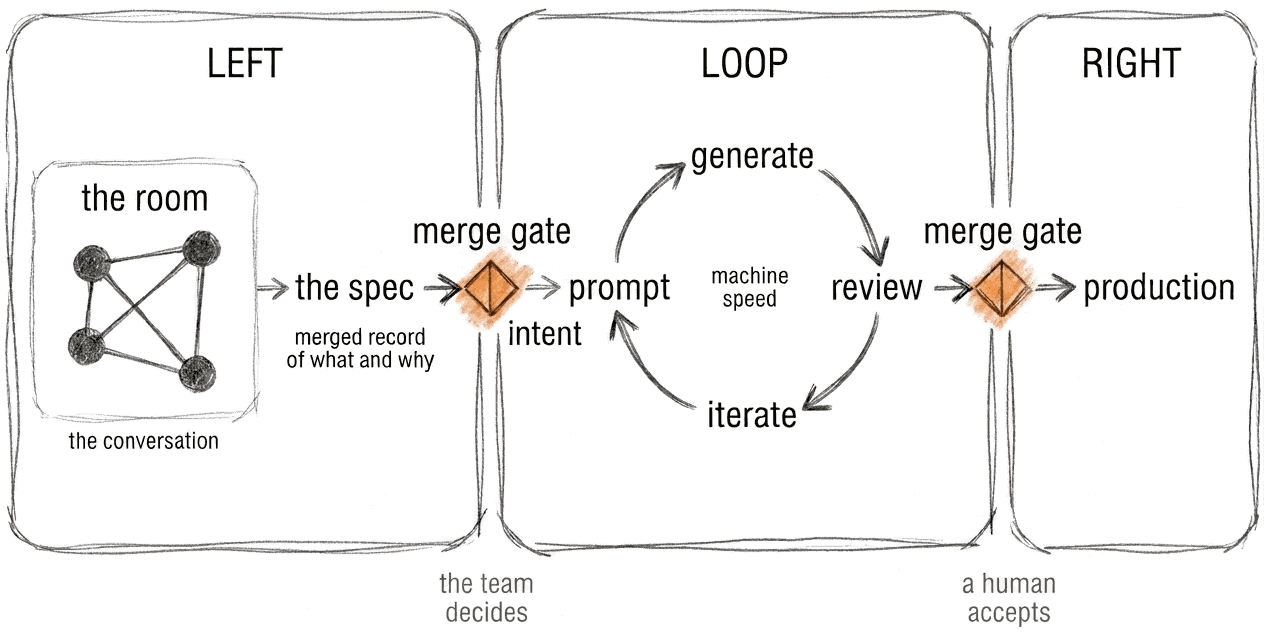
Left of the loop is where the understanding gets built. The loop is where the code gets written.
The draft is free and stays free. Buying it early is the
most useful kind of support there is: it says the book is worth finishing
while there's still time to shape what it becomes.
Further reading — the running version of the list at the back of the book
The appendices freeze when the draft is printed; these two pages
keep moving. The templates are CC BY 4.0, so you can use and adapt them at
work without asking.
This book looks like a book about AI: agents, specs, workflows, the
changing shape of software development. All of that is in here, and
none of it is what the book is about. It is about what a team is for
when implementation is no longer the hard part.
What that means started with a university friend and 18 PlayStation
Move controllers.
The two of us were building a KubeCon demo for a talk called “18
Bluetooth Controllers Walk Into a Bar.” We talked about
observability and runtime configuration for JoustMania, an open-source
party game where players jostle motion controllers until someone falls
over. Complex execution: multiple Bluetooth adapters, battery-powered
devices, sensors firing at 100Hz. When a player complains their
controller “felt different,” how do you find out what
happened at 2 a.m. at a convention? We wanted to figure out what was
actually happening while it was still happening.
An interesting problem, and two people who knew the domain and cared
about the project.
Because we had different schedules, we just started hacking on our
own. We both made progress. We moved fast.
And we never planned it together.
The knowledge gap opened quietly and decisions got made that the other
person didn't know about. Assumptions turned out not to be shared and
work that should have built on itself didn't fit. Not because either
of us was wrong, but because we never built the shared picture before
we started building the thing.
The full draft continues in the PDF.
The argument, chapter by chapter
Each chapter answers the question the one before it
raised. That chain is the book.
The Curse of SisyphusIf implementation is the cheap part, where does the hard part go?
The End of a Craft?If the agent does the building, what's left that only a person can do?
A Fool with a Tool is Still a FoolIf judgment is the craft that's left, what does it catch that the tool can't?
The Product Owner is Dead. Long Live Product Thinking.If the team can catch the wrong shape, who catches the wrong ask?
The AgoraIf no one person owns the understanding, what does it take for a team to build it together?
The Ever-Agreeing GenieIf a team builds understanding together, what keeps it honest?
The Alexandria ProblemIf the understanding holds today, how does it survive the people who leave?
The OracleIf you can't see understanding, how do you know it's there?
The TriremeIf predictability is the proof, what kind of team produces it?
The AstrolabeIf one team can sustain it, how does it scale to many without thinning?
The Forest and the DesertIf the right structure holds understanding, what keeps it alive over time?
The PhoenixIf all of this is possible, what do you choose?